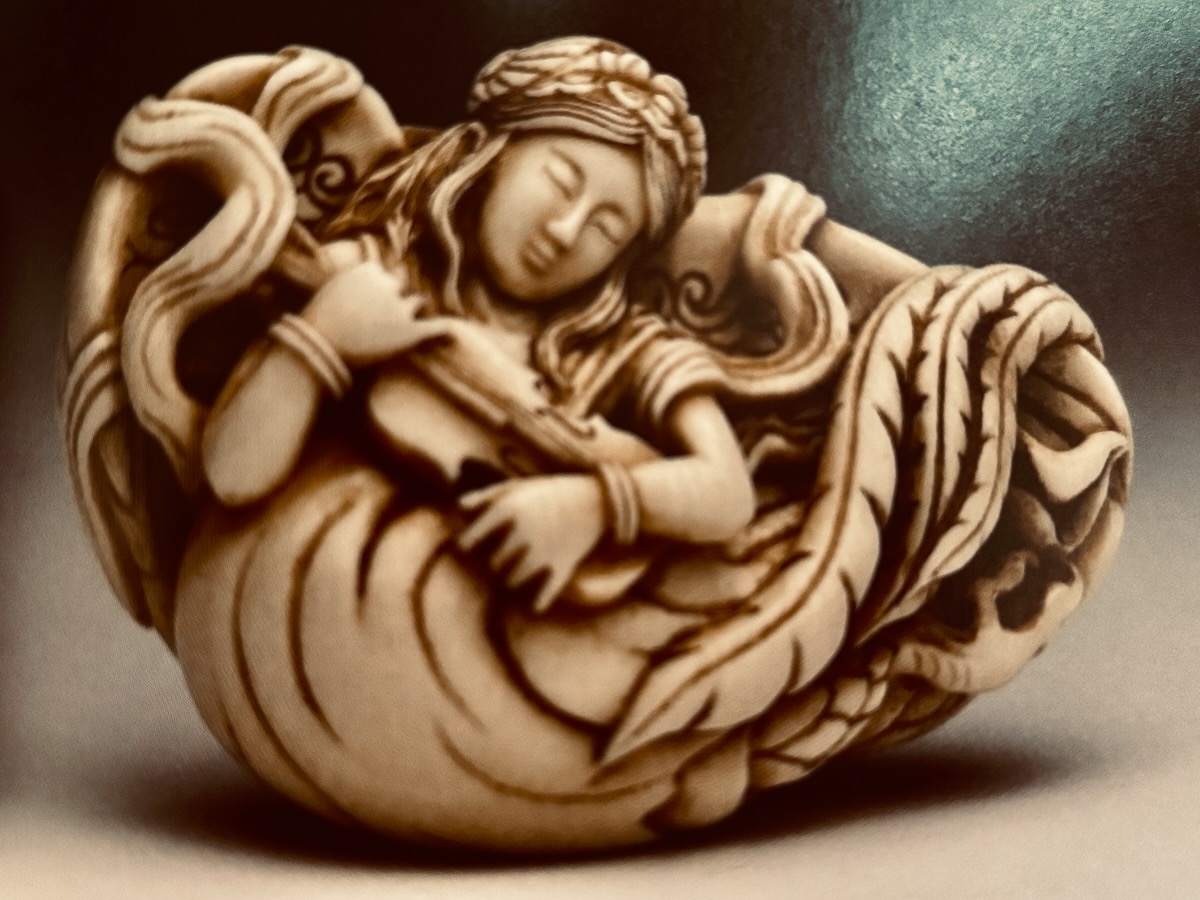
In this scene from Fireworks and Other Illuminations, Regina finds herself in a Kyoto antique shop, captivated by an erotic netsuke—a carved ivory sculpture no larger than a thumb—of a bound geisha. As she holds it, an imagined story unfurls in her mind, merging art, desire, and violence. This is Regina’s private tale – one that reveals both her fascination with beauty and her keen awareness of the fine line between pleasure and brutality.
“A long time ago, when artists were still regarded as treasures and warriors still carried their swords, there lived a courtesan named Niko—famous for her conversation, singing, and versatility. All her patrons were celebrated and powerful men…
This is what I heard…
The Artist comes early in the morning, when the sun just begins painting the sky with strokes of mauve, peach, and sage. On his right shoulder he carries a silk furoshiki full of parchments, inks, brushes, and other tools of his art. He wakes his lover with butterfly kisses and gentle caresses, making sure that he attends to every mō of her smooth and supple body. He takes silk ropes from his bundle and watches Niko in wonder, composing in his mind a shibari he is about to create. The Artist takes time binding his lover with skill and care, assuring her utmost pleasure. As he advances from one stage to the next, he tests his work as well as the depths and heights of Niko’s pleasure, cherishing every climax she achieves. And when he judges the masterpiece complete, he slides his loving hands over Niko’s slender shoulders and back towards her hips and slowly pulls her onto himself, moving deep into her, as she screams in joy and ecstasy…
The Warrior comes when the pines around the house are drowned in darkness, carrying on his left shoulder a coil of the coarsest ropes. As she listens to the sounds of her servants unbuckling the Warrior out of his armor, Niko braces herself for a struggle. She knows that it is expected of her. This is what the Warrior enjoys. As he grabs her, Niko flutters in his rough and brutal hands like a precious koi. The coarse rope scrapes Niko’s pearly skin; deep clutches and hard pinches bruise her flesh. Her back pressed to the tatami, she clenches her teeth and turns her face away from his cruel smile while he attacks her insides and twists her roped breasts with all his savage might. He slams deeper and deeper into her until she cries out in anguish and ecstasy…“
Writing this scene allowed me to explore how art—whether carved, painted, or performed—can carry both erotic charge and darker undercurrents. I wrote it to illustrate Regina’s own complex relationship with beauty, control, and submission—and how these ideas simmer beneath the surface of her life…
What do you think Niko represents to Regina in this moment? Is she just admiring the master artistry, or is something deeper stirring?
You can read more about Regina’s journey in Fireworks and Other Illuminations.
P.S. Many creators before me have been deeply moved by the ability of old Japanese master carvers to convey vivid stories through their miniature netsuke creations. Poets, novelists, and philosophers alike have reflected on the powerful emotions evoked by this unique art form. And—since I’ve been studying, adoring, and collecting netsukes most of my life—the idea that one of the carvings described in this novel might inspire my heroine into imagining such a tale feels inevitable.
Yet, I cannot be absolutely sure of it. Somewhere in the deep layers of my cultural memory reside vivid impressions left by someone else’s imaginative adoration of netsukes. And I feel obligated to give credit where it’s due.
The Soviet miniseries Krosh’s Holidays (directed by Gregory Aronov, screenplay by Anatoly Rybakov, based on his novel) first aired in 1980. It was a somewhat unusual show— a teen detective mystery, a genre virtually nonexistent in Soviet literature and cinema. The plot centered around the sordid machinations of unscrupulous art collectors—an unexpectedly bourgeois subject for a communist regime. And, as you might guess, the objects of this collecting obsession were netsukes—an art form unfamiliar to most Soviet audiences.
I don’t have viewership data, but I know this: everyone I knew in Russia at the time saw it. And we were all deeply affected—mesmerized—by how the filmmakers spotlighted those miniature carvings. Slow-motion close-ups of each netsuke were accompanied by meditative elegies narrated in Japanese style. The effect was unforgettable.
So, consider this story of Niko my homage to the imaginations of Anatoly Rybakov and Grigory Aronov.
Incidentally, my next post will be devoted to the subject of literary and cinematic homages, tributes, and borrowings…
Discover more from Miriam Cohen's Secrets of Romantic Fairy Tales
Subscribe to get the latest posts sent to your email.

