
In the hush of libraries and art galleries, in front of screens and stages – a quiet heist unfolds daily…
Artists lift from artists, writers borrow from writers, and everyone insists it’s an homage. It’s not easy to draw a line between inspiration and theft, between respectful tribute and outright poaching.
And it doesn’t matter whether the content is analog or digital, high or low-concept, traditional or ultra-contemporary. The more of it we create, the harder it is to tell what’s charmingly respectful and what’s obnoxiously unacceptable.
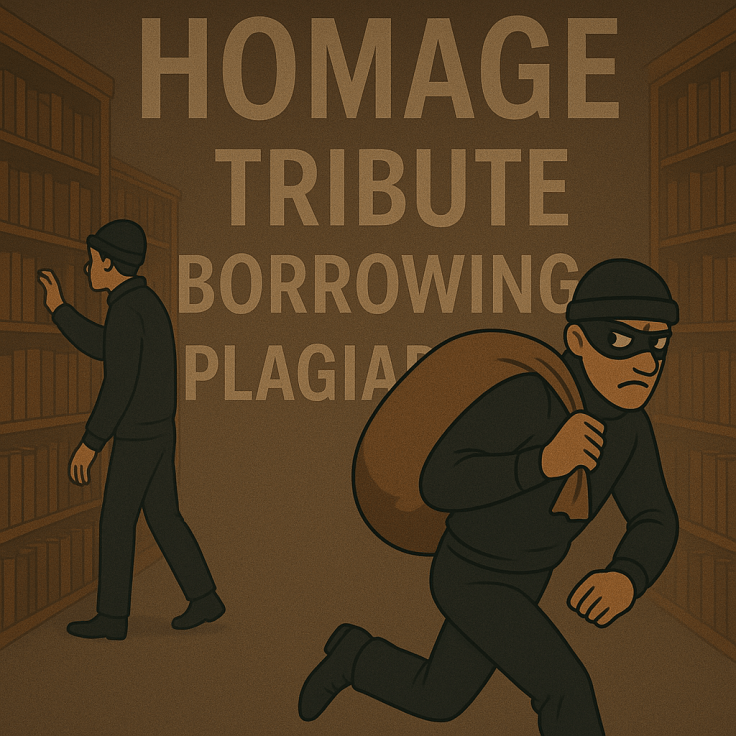
Of course, if someone tries to pass the original work as his own – there is no ambiguity about that. That’s clinical plagiarism. Beyond that, it’s murky waters.
In this post, we step into the shadowy aisles of gray areas—where the creative larceny frequently hides behind a mask…
The problem of good memory
I guess it varies from person to person. And maybe some marketers do study the patterns of info absorption by the general population. I don’t know. All I can say is that I have what some may call an “unhelpfully” good memory for story beats and narrative details. And what ends up happening is that when I watch or read something, I can’t help but notice the echoes—some gentle nods, others blatant grabs—from works past.
It’s not that I feel special about it. It’s one of those things: a blessing and a curse. I can’t really help it: the firecrackers just pop inside my head without any particular effort. And I have to admit: most people would classify some of those interconnections as obscure…
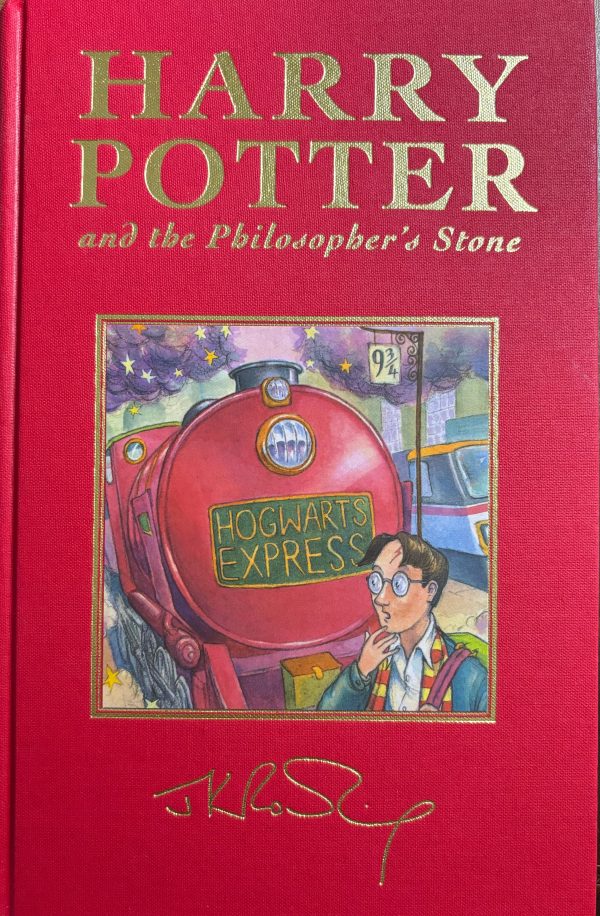
Here’s an easy example. Back in 1998, I did a lot of puffing and huffing over the Bloomsbury edition of Harry Potter and the Philosopher’s Stone, which I just brought from London. Dumbledore—that’s Sherwood-Forest slang crossed with French, results in Stream of Gold! Severus—that means strict in Latin! The three-headed dog used to guard the entrance to the underworld! Of course, he was known as Cerberus, not Fluffy at the time.
But even more maddening for someone like me: The CHANGING STAIRS! That’s straight from dear Dorothy L. Sayers’s Gaudy Night. It’s where Harriet Vane describes her alma mater, Oxford’s Shrewsbury College, as an incredibly confusing place with seemingly moving stairs. And “goblins in the bank”—that what British citizens used to call their money they just started depositing during Victorian times.
But again, who can possibly remember such things besides me… and J.K. Rowling, I guess? By the time The Deathly Hallows were delivered to my door on the day of its American release, I had a small notebook full of what I then considered her “borrowings”.
But so what? She read (as they say in UK) the classics at the university and she is a literary person. Of course, she employs her erudition in her writing. Don’t we all? Plus, she created an entire world populated by characters millions and millions of people adore, cherish, or abhor. The world owes her gratitude. Transferring the moving stairs from Dorothy L. Sayers’s Oxford into Hogwarts… I am much mellower now – let it be an homage.
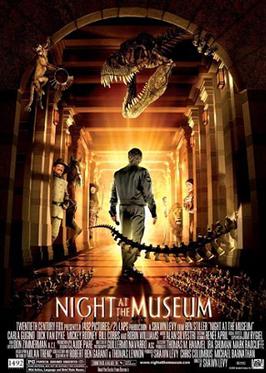
However, I feel very differently about the shock I experienced nearly 20 years ago, when I saw for the first time the poster of Night at the Museum (2006)—dear Robin Williams peeking out in that Teddy Roosevelt getup. I will never get over it. Even without reading any loglines or seeing any trailers, I immediately knew that this was a Hollywood mash-up. They took Milan Trenc‘s children-book premise of coming-alive dinosaurs (granted, duly credited) and enriched it with human historical characters doing the same…
And I’ve already read it! Teddy Roosevelt and several other presidents, and their wives, and a few additional famous individuals of the past came alive before—in Gore Vidal‘s The Smithsonian Institution (1998)! So, where is the credit to that direct borrowing? Nowhere to be found.
It’s hard for me to believe that absolutely no one on the movie’s production team was aware of it. I haven’t seen either the original or the sequel, but isn’t the latter actually takes place at the Smithsonian? Bold! By the way, it’s Chris Columbus’s production. He directed the first two Harry Potter movies. Uncanny, isn’t it?
Nothing can be done about it, you know. “Ideas” per se are not protected by the copyright laws. This is how it’s done on daily basis. You can pitch your original project, get it rejected, and then someone else makes it…
The myth of “Originality”
Okay, so maybe my brain goes too far with the obscure details borrowed by various content makers. But how about the entire narrative arcs and crucial plot points?! Especially if you consider that in the past I used to define “creative originality” in the most absolute, the most uncompromising terms possible. If I could recall a similar idea used in a prior work —it was recycling to me.
Again, clever J.K. Rowling and her first installment of Harry James Potter saga came under the fire of my “unoriginal” scorn as well. My brain instantly associated the premise with another quite popular children fantasy novel—Roald Dahl’s 1961 James and the Giant Peach. The tale of an orphan boy James Henry Trotter, whose loving parents were destroyed by a brutal rhino and who is forced to live with his cruel aunts until a magician helps him to get out.
As mellowed down as I am now, it still irks me that she’s never acknowledged the influence of it. Not even a subconscious impact? She always says that it all came from her head. And I agree—from her head, full of good books she’s read. And I don’t think that her readers would’ve held the admission of an inspiration against her.
As the illegitimately legal lead of Suits, Mike Ross, proclaimed in the episode She Knows (S2E1), “There is nothing new under the sun.” He was facing a publishing assistant who sued her former publishing-house employer for “stealing” her pitch and giving it to someone else to write. To force the claimant into accepting a settlement, Mike utilized his ultra-genius info-absorption abilities. He scanned the publisher’s catalog for the past five years and came up with three (!) novels that could’ve been written based on the very same pitch. Only they weren’t because they were published years ago.
I mean, so many of Shakespeare‘s plays are based on the stories that were created before him. The scholars suggest that only Love’s Labour’s Lost and The Tempest can be considered entirely original. Hamlet has its roots in the 13th-century chronicle of Amleth. King Lear is based on a mythological Leir of Britain. There are monographs upon monographs detailing the various sources of The Taming of the Shrew. And so on and so forth…
At the end of the day, it’s not about the Bard’s plot sources. It’s about what he did with them—how he developed the characters and their stories, making them his own. It’s the unprecedented mastery of the language he summoned from within to penetrate our hearts and capture our minds. Most importantly, he never just copied and pasted anyone’s phraseology or imagery. He just got inspired… and the rest is the matter of immortality.
The healthy familiarity
My daughter recently resurfaced her complaint about my old and retired “has-been-done-fascism”, as she calls it. “You used to habitually bring up cultural references in response to many of my ideas,” she grumbled, “You paralyzed me with it.” (Oh, dear, I regret it so terribly!)
She is the one who brought to my attention the theories of familiarity vs. novelty balance. It turns out that this balance is a key to captivating and retaining people’s interest. Too much novelty is found to be overwhelming for the general public. And it’s the creator’s task to find what the theoreticians call a “sweet spot”.
When you start researching this topic, you inevitably encounter MAYA (Most Advance Yet Acceptable) Principle. It suggests that people prefer novelty in small doses, intertwined with familiar and comfortable elements to meet the users’ expectations. Interestingly enough, this concept originated in the realm of industrial design. Yet, its universal applicability made it into a practical rule of thumb across the board.
Look, this blog is called Secrets of Romantic Fairy Tales—with an explicit implication that there are fundamental principles, rules, tropes, and structural elements that are not just recurrent, but essentially unavoidable in building a narrative… In Chapter 20 of Fireworks and Other Illuminations, Regina and William talk about this very subject—the perpetual continuity of timeless storylines…
“’You see, all these human tragedies, comedies, dramas, mysteries, romances, fantasies – they all repeat themselves, because… Well, because they are human stories told by humans.’
‘I know,’ William sighs, ‘At the end of the day, we are all built with the same set of emotional receptacles and response mechanisms…’
‘Exactly. I think this is why religion, marketing, and ideological propaganda work universally on such huge groups of people. And this is why the same stories are being retold over and over again, using the same millennia-old formulas.’
‘It’s all about making it your own, isn’t it?’”
p. 423
So, clearly I came to accept that some level familiarity is highly recommended. It is—at least from the standpoint of consumer marketing—healthy for any creative product…
…Yet, there are the shameless
Some content creators, though, just push the limits of decency too far. Especially those in the business—as I call it—of quilting, i.e. piecing their fabrications out of the snippets snatched from other creators’ material.
And it’s quite possible that their mind-blowing success derives precisely from this very methodology of exploiting the work of others, incorporating into their designs the multitude of cultural bits already proven to be effective. The audience doesn’t necessarily recall the original sources, but the subconscious familiarity puts people at ease.
But to me, with my reference-serving memory, it’s like the sensorial overload: non-stop flashes inside my head. All I see is: usurpation…
In my endless pursuit of the compassionate closeness with my readers, I would like to attempt here a simulation of the way I experience the quilted content. So, here are a few illustrations of what happens inside my head:
- Cersei and Jaime Lannister AND the Red Wedding 🤯 John Ford’s ‘Tis Pity She’s a Whore (1633)
- The House of Stark’s mandate of personally beheading their guilty subjects 🤯 The ancient Japanese shōgun tradition.
All posh and historical (and less recognizable) for the scholarly dude that he is, of course.
What about romance—you wonder? Here: this author was inevitably affected by her 25-year career in television. So, she primarily helped herself to the plethora of on-screen resources. With the heavy re-purposing she managed to generate quite a global footprint – 165 mil of books sold, apparently.
- BDSM’ing Mr. Grey 🤯 Bitch, puh-lease! The 2002 indie gem Secretary, starring glorious James Spader as dominating and punishing E. Edward Grey and Maggie Gyllenhaal as his obedient personal assistant. And guess what? For quite some time IMDb featured the movie’s classic assume-the-position poster
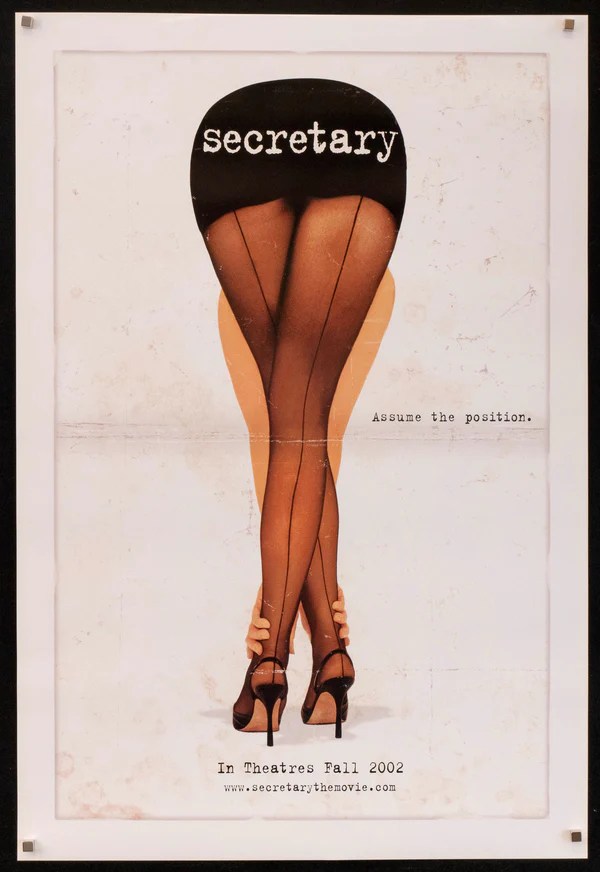 with the phrase “The Original Mr. Grey” printed over it. I should’ve saved it. Because it’s gone now—from everywhere in the universe, actually… Billions can buy a lot of litigation and PR power, you know…
 - The Hero adores the little “v” that forms between the heroine’s eyebrows, when she is perplexed by something. 🤯 In her screenplay for When Harry Met Sally... (1989), Nora Ephron wrote: “I love that you get a little crinkle over your nose when you’re looking at me like I’m nuts.”
- The Hero explains his rushed marriage proposal: when you know who you want to spend the rest of your life with, you want it to happen as soon as possible. 🤯 In the very same screenplay Nora Ephron wrote: “When you realize that you want to spend the rest of your life with somebody, you want the rest of your life to start as soon as possible.”
- The adopted Hero shares: “The woman who brought me into this world was a crack whore… She died when I was four.” 🤯 Dexter Morgan‘s mother put little Dexter in danger by exposing him to drug dealers. Dexter was two when they sawed her apart, still…
- The Hero asks, “Are you coming or going?” The Heroine replies, “Coming… Oh, I hope so“. 🤯 Even if you don’t remember anything from Queer As Folk (US) and even if you didn’t watch it all that much, you probably know this—it’s iconic: “So, are you coming or going? Or coming and then going? Or coming and staying?”
- There is a scene with surprising billiard skills. 🤯 The Time Traveler’s Wife…
And so on, and so forth… The list is endless—as I said, it’s a quilt of shameless borrowings, and the stitches are quite visible.
On the other hand, an homage in its absolute purity…
Don’t get me wrong here—I’m actually a sucker for a pure, high-quality, subtle homage. And it invariably gives me an absolute pleasure when I spot one…
…Andrei Tarkovsky in Solaris emulating Rembrandt’s The Return of the Prodigal Son (Regina’s favorite Rembrandt) as an actual film sequence… And decorating the interstellar space station with paintings by Pieter Bruegel the Elder as a reference to the eternity of human emotions…
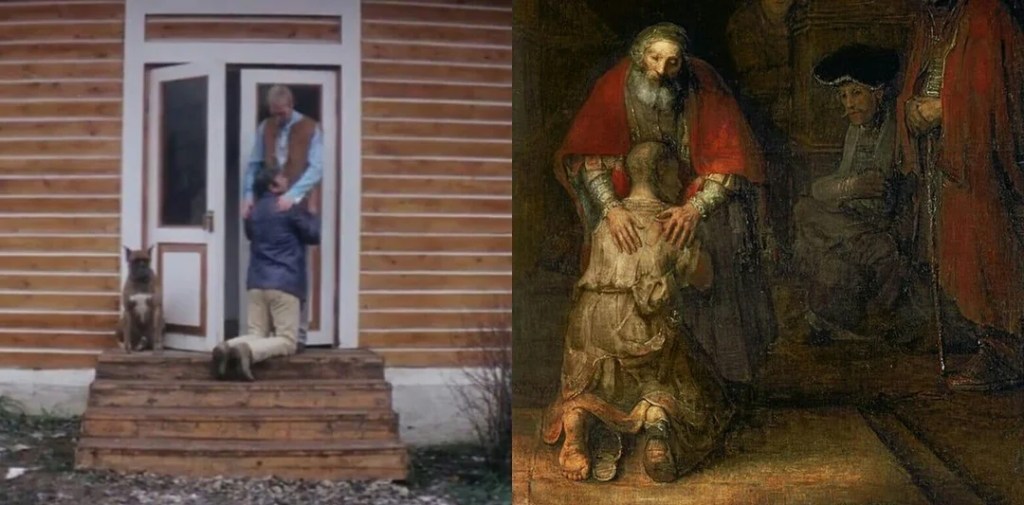
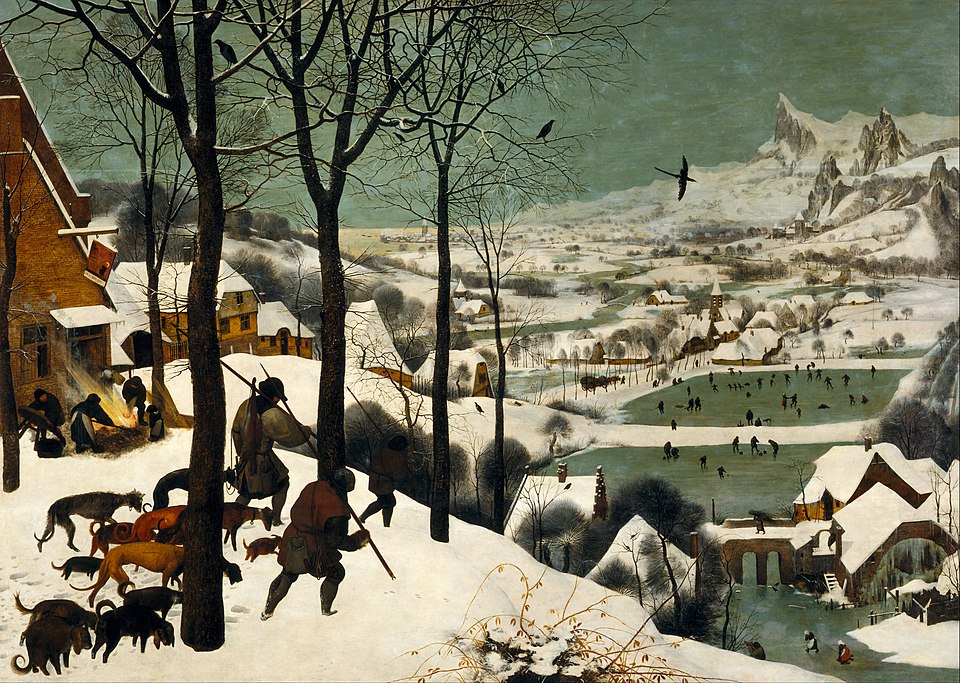
…Decades later, the self-described Tarkovsky’s admirer Lars von Trier acknowledging his deep connection with the master by citing The Hunters in the Snow in Melancholia and Mirror‘s rolling greens in Antichrist… Reutilizing the tableau-vivant technique film after film (Lars Von Trier’s Paintings References)…
…Quentin Tarantino channelling his gratitude to the Spaghetti-Western ethos of Sergio Leone and the stylized martial-arts choreography of Hong Kong cinema in his own masterpieces—Reservoir Dogs, Pulp Fiction, Kill Bill 1 & 2… And now: since the late 90s, practically every single cerebral action flick carries a genetic element of Tarantino influence…
…The Byzantine concept of a woman with powers of Vortex reimagined by that celebrated appropriator of everything myths and folklore Neil Gaiman in The Sandman and also by Timur Bekmambetov in Night Watch. The latter’s title is the reference to another famous Rembrandt—there is a glimpse of it in the film…
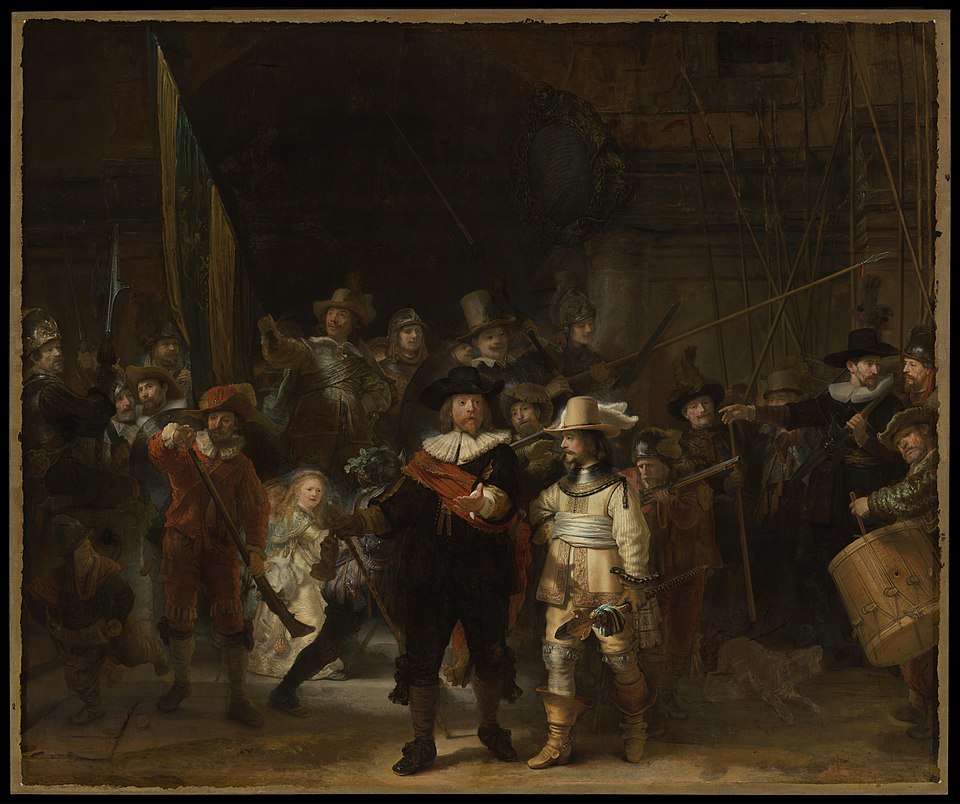
One artist, acknowledging the profound impact the genius of another artist had on his creative formation – that’s purity… I aspire to that kind of reverential virtue…
In fact, in addition to the numerous direct references to specific works of art, theater, cinema, and literature, Fireworks and Other Illuminations is full of homages. They manifest my admiration of classical and pop-cultural creations that I consider iconic.
I’ll tell you what, if you spotted any of those homages, I invite you to email me and let me know. Every kind reader who names at least one correctly will receive a PDF of the novel’s unpublished alternative ending.
Discover more from Miriam Cohen's Secrets of Romantic Fairy Tales
Subscribe to get the latest posts sent to your email.

