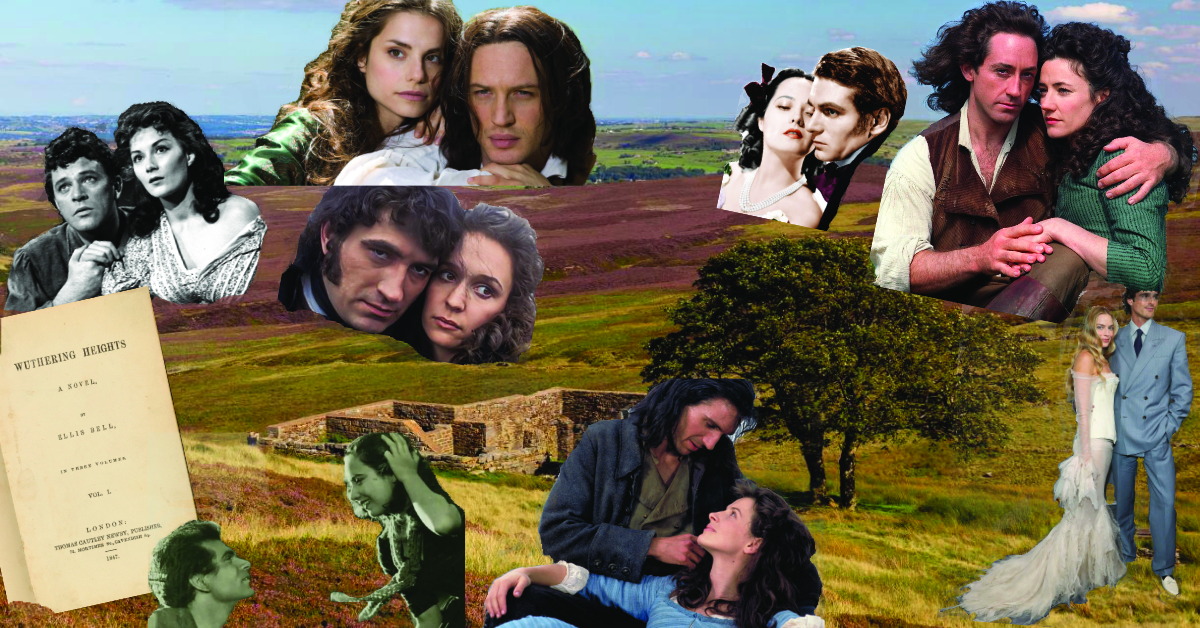
Speaking of romantic heroes…
Catching all these glimpses of teasers and trailers for the latest film adaptation of Wuthering Heights1 inevitably reminded me how much I disliked the novel all those decades back when I read it. Still vividly recalling the experience of it, I have to admit that my sentiments have not changed. It left a long-lasting impression of horror and… disappointment. My expectations were betrayed…
I remember being so exhausted by all that tedious descriptions of passions of the heart. It felt so… artificial, so made-up. Naively imagined rather than experienced from the core of one’s being…
That was definitely my main, but not the only, complaint. It irked me that, in spite of the changing point of views, all the narrators—servant or gentry—spoke in the same “voice”… Plus, underdeveloped characters and unrealized storylines… And the pervasive fixation with multi-generational sadistic cruelty… How is it “one of the greatest novels to be written in English”?
But it’s not just the literary merits issue, isn’t it?
The shock value
Honestly, I’ve always thought that the Brontë sisters were determined to shock the narrow-minded circles of the polite society by exposing its weaknesses, blemishes, and hidden longings. As former governesses, they surely had plenty of reasons to feel vengeful. After all, the tradition of mistreating people in one’s private employ, especially women, persists even in our supposedly “more liberal” times. It is very likely that the ensuing critical outrage was an intended aim.
However, fictionalizing societal perversity and challenging audience’s morality for the sake of pure shock value rarely results in coherent storytelling. More frequently than not the outcomes are messy, disjointed, and… hmm… for the lack of a better word… unpleasant. And if that what Emily Brontë was after, she truly succeeded. The sum of the negative emotions she evoked with her writing is epic.
Actually, of the three sisters, only Charlotte managed to create a groundbreaking masterpiece of true Gothic romance. It is populated by relatable, emotionally rich characters, whose story arcs actually keep the readers captivated throughout the entire book.
I believe that Jane Eyre’s literary strength and enduring readership has a lot to do with the fact that its Mr. Rochester is an authentic romantic hero. The kind of a man who is willing to violate human laws and condemn his soul to damnation so that he is united with the woman he loves… A noble man who keeps caring for his insane, violent wife. As well as a responsible guardian to his minor charge Adele.
Where the romantic hero at?
On the other hand, Heathcliff is marred by his toxic obsession and all-consuming thirst for revenge… Drowning in the hatred of self and others, burning with ruthless cruelty—he obliterates lives around him. How can a person like that have any claims on Love?
Whether she knew it or not, her depiction of what we recognize today as a clinical behavioral pattern of the abused victim becoming an abuser can definitely be counted as Emily Brontë ‘s achievement. I hope there are some Brontë scholars out there who acknowledge the fact that Heathcliff is at the center of this abuse cycle. A position of incredible pain and darkness. His brutality is by no means excusable, but at least it’s psychologically graspable.
Of course, cerebral comprehension has nothing to do with our emotional response to violence. I am still able to relive the heartache I experienced while reading how this tragic demon moved to hit the bewildered, kidnapped, and held captive Cathy Linton. After hundreds of pages worth of drivel and hearsay, the narrative finally made a powerful impact. I’m sure that the particular horror of that moment was poured onto the page out of a firsthand trauma—borne or witnessed.
That said, I hope that you agree with me that even under the darkest of Gothic canons, Heathcliff cannot be defined as a “romantic hero”. After all, the subgenre of Gothic romance is usually distinguished by the dark and arduous ordeals a heroine endures to be with her beloved, not by the horrors the protagonist dispenses on everyone around him. And it doesn’t matter if his violence is motivated by his obsessive passion. Maybe the reason the Victorian readers felt confused and unsettled by the novel was precisely because the author placed this brutal beast at the centre of an amorous plot…
It is also quite frustrating that his storyline is incredibly underdeveloped and neglected. Maybe for the sake of the mysterious aura, but most likely because the author simply didn’t have enough material to flesh it out… Where did he go? What happened to him while he was away? How did he made his fortune? Most importantly—what kind of struggles are brewing inside?
Give credit where credit is due…
The contemporary critics—those who insist on keeping the Brontë flame alive—have a tendency of labeling Wuthering Heights “controversial for its times”. And, yes, it was divisive alright as the majority of readers were appalled by it. But not for the reasons the modern analysts outline.
For example, in an attempt to give the novel “broader” significance, the depiction of mental and physical cruelty towards children is frequently cited. Yet, I can’t accept that claim. Let me remind you that ten years before this book came out, Victorian readers have already embraced Dickens. They cried their hearts out over the terrible mistreatment that befell poor Oliver Twist.
Another recurrent tribute concerns Brontë’s largely convoluted dealings with the complexities of the property, inheritance, and widowhood laws. You need to be well-read in the history of the British estate code in order to untangle the knotty threads of Heathcliff’s dirty ownership manipulations. Alternatively, you can just skim through the pages and leave the matter as muddled as is. Isn’t that what most of the adapters do?
Let me remind you, though, that thirty five years before the Brontës, Jane Austin was far more compelling and heartbreaking (as well as romantic) about the plight of women under the discriminatory property laws, which denied them the independent ownership. The plots of her first two novels—Sense and Sensibility (1811) and Pride and Prejudice (1813)—are firmly rooted in the common scenario of daughters being forced out of their homes and into poverty upon their father’s death. As clear as a bell.
Some of the more recent overthinkers go even as far as to mythologize Wuthering Heights as a feminist antithesis to Milton’s “patriarchal” Paradise Lost… Puh-lease! I’m not going to dignify these pseudo-philosophers by arguing against them.
But here is a real controversy for your consideration…
The prevailing liberal consensus is that the obscurity of Heathcliff’s origins is a deliberate writing tool. It emphasizes his position of an outsider and his role of a wrecking ball— crushing the Establishment around him. Hmm… Very advanced thinking. And maybe I would agree with this point of view… If only his enigma was limited to his introduction into the story. Picked off the streets—no name, no parents, no memories…
Yet, it’s not like Ms. Brontë tastefully leaves it at that. No, he is found in Liverpool—back at the story’s outset of 1771 still very much the hub of the slavery trade. And he is “dark” with “black eyes”. A gypsy? Mulatto? Some oriental “royalty” as Nelly foolishly suggest (I mean, there is not a shred of nobility in the beast)? Oh, no—a Middle-Easterner? Why is it not clearly disclosed? What is the implication here? Is that where his savagery comes from?
The young, impressionable, politically and ethnically persecuted Soviet Jew that I was at the time of the reading—I simply couldn’t help myself seeing straight into the heart of that bigotry. And all these years later, I hadn’t changed my mind. Whether my contemporaries pretend not to see it or not, I believe that it’s exactly what Emily Brontë wrote. Heathcliff’s untamed passions and his monstrous brutality are both ethnically determined.
And it’s possible that the post-abolition Victorian society was just as appalled by that notion as I was. Well, that plus the clashing of their literary expectations against the idea of a despicable abuser as a romantic hero.
Adaptation by sterilization
It’s my understanding that this latest adaptation attempts to dilute the violence by introducing the Fifty-Shades aspects into Heathcliff’s relationship with his unfortunate wife… It’s misguided, of course. Technically, the one enduring the pain should have all the power and all poor Isabella wanted was to escape. Still, I’ve got to give it to the creative team behind it: at least they acknowledge the presence of the Gothic terror. Which is more than can be said about the majority of the previous adaptations.
Believe it or not—practically all of the prior translators of the novel into the performing arts chose to sanitize Heathcliff’s violence out. Many of them (with only one or two exceptions) just dropped the second—the brutal one—half of the story altogether. And with it, I must note, the second generation of characters and their—far more compelling—romantic aspirations. I wonder what would Emily herself think of that? She is probably turning in her grave…
And I am not exaggerating either: there are genuinely “many” movies, series, and even a play. I know of at least thirty produced in different countries from 1920 to now. And I’m sure there are more… You can’t even imagine how many people conglomerated images from these numerous adaptations into their own collages. They are far more elaborate than mine. And I’m sure there are plenty of blog posts about them as well…
Considering that in the past 100 years the general public largely transitioned from reading to viewing, I believe that these pick-and-choose popularizers are the ones responsible for the misinterpretation of the novel as “romantic”. And yet, no matter how much they push, no one has succeeded in making either the audience or the critics to truly fall in love… “Mixed reviews” is the most they can plow out of Emily Brontë’s opus… Am I surprised?
Hmm… But maybe, just maybe… Is it possible that Ms. Fennell is onto something here? I mean, the Fifty Shades products targeted the most basic of audience’s instincts and garnered wild popularity! Perhaps Emily Brontë was the forerunner of such British female writers as E.M. Hull and E.L. James, who achieved a widespread international readership precisely because of the sexual perversity of violent beatings and abuse…
Is this why Wuthering Heights endures? Is that what the uninhibited by the cultural revolution public really wants? Is this the reason why the novel suddenly got labeled a “masterpiece” in the 20th century? Is that’s why the romanticized adaptations don’t succeed —because the contemporary audience is disappointed by their lack of violence?
What do you think?
Interested to see how William McGrath diametrically differs from Heathcliff as a romantic hero, visit the novel’s Landing Page–>Fireworks and Other Illuminations
- Written and directed by Emerald Fennell – the actress who played young Camilla Parker Bowles in the two middle seasons of Peter Morgan’s The Crown. Her father is a famous jewelry designer—hence, the name, I’m guessing. ↩︎
Discover more from Miriam Cohen's Secrets of Romantic Fairy Tales
Subscribe to get the latest posts sent to your email.

