
Recently, I was reading Marina Zosya’s memoir I Built This Prison…
(Forgive me: I sound like Tom Riddle, duping poor Slughorn into explaining horcruxes: “I was in the library the other night… In the restricted section…” But I guess all setups sound a bit artificial, don’t they?)
The book turned out to be quite brainy and full of literary and pop-culture references. Especially throughout the essays of Part III – Impressions of Imprisonment. In one of them, Gender Politics and Other Divides, the author shares her insights into many reasons behind the imprisoned women’s separation into groups and cliques. Yet, she accurately notes, “as it follows from the laws of physics and logic, where are divides, there are must be unifiers as well.” It was endearing to discover that Vestron Pictures’ surprise hit Dirty Dancing proved to have such unifying power – appealing to women of all ages, races, orientations, personality types, and standpoints.
The long-lasting spell…
Before I say anything else about it, let me just state that, like many others, I too have been captivated by this film ever since I first saw it in the late 80's... It’s impossible for me to count how many times I’ve re-watched it… I first had it on VHS, then on DVD, then I got this special edition with all the interviews, and auditions… Plus, it has always been one of the Basic Cable’s staples…
And invariably, the phenomenal emotional pull of the love story between Frances “Baby” Houseman and Johnny Castle, unfolding over 100 minutes of the celluloid time, leaves me… hmm… a little puzzled. The truth is – if one can manage to resurface out of the pool of warm feelings and take a lungful of cold intellectual air – the affection we feel for this film is a bit of a mystery!
Cinematically speaking…
Let’s be honest here: From a viewpoint of pure critical analysis, it’s not really a very good movie. The directions are choppy at best, cinematography is unimpressive, editing is wanting. And don’t get me started on the subpar acting all around. Jennifer Grey (in her then still lovable natural state) and her marvelous laugh being the only exceptions. And the dialogues! I mean, Pulp Fiction it ain’t!
Plus, the problematic screenwriting… Especially when it comes to Baby’s character transitions. First she crushes on Penny and Johnny as a marvelous dancing couple, then on Penny (“I envy you…”), and finally on Johnny… I also take particular issue with that persistently overused cliche: her expedient transformation from a naive and awkward duckling into a sensually wanton swan – in a span of a few days. All leading to the finale that leaves the audience on an artificially high note of uncertainty: “What’s next?”
(And one more thing, which is personal to me and probably not very relevant to the majority of the movie’s fans. Nevertheless, I feel that the filmmakers blatantly insulted Ayn Rand by placing The Fountainhead into the unworthy hands of Robbie-the-creep.)
Oh, I know, I know: normal people just embrace the wonder of it and let the heart deal with the affectionate feelings. It’s like the Love itself – why bother with explanations? But I’m not “normal people”. “Normal” doesn’t want anything to do with me. Of course, I would never claim that my idiosyncrasies make me in any way “special”. However, they do force me to ponder, dwell, and over-analyze.
The origin of magic…
So, what is it about this film that resonates so deeply? How does this small, flawed movie continue to enchant worldwide audiences?1
So, let me tell you where all that contemplating led me. At its core, Dirty Dancing triumphs in depicting two classic tropes of the fairy-tale romancing: Love is Blind and Love Conquers All. And therein lies its power.
Enamored Johnny stops registering Baby’s awkwardness, childishness, stiffness, her familial dependence, and the appearance of privilege. What becomes relevant to him are the things you can’t see with your eyes: her heart, will, unbiased honesty, disarming fairness, and humanity. And Baby… she worships Johnny, defending him against all who underestimates him. If her father wasn’t given an opportunity of realizing the truth… Who knows?
For these two characters Love becomes a potent instrument of empowerment. It inspires them to do things they didn’t know they could. It is the force that demolishes all barriers and wins all battles. An equalizer that makes them stronger than the entire world and its realities. And that what makes the viewers’ hearts beat faster.
The critical game changer…
Interestingly, in step with the time it depicts (it is set in the early 60’s, after all), the film flips the traditional fairy-tale scrip. Here, it’s not Johnny – as well-shaped and smoothly-gliding as he is – who is the true "Prince" of this romance. It’s Baby. She is the one with the heroic courage, straightforward convictions, and unyielding urge to rescue. Her attitude of never hiding from the fight ends up affecting practically everyone. And Johnny sees her as a warrior, a person of extraordinary strength. He’d never met anyone like that.
And let’s not forget that she is the one making the first move towards the hesitant and unsure Johnny with the simple yet powerful invitation: “Dance with me…”
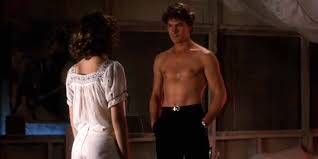
Also – and this is not a trivial materialistic matter, but a crucial princely characteristic I will be discussing at length in the future – she has access to funds that can make a difference in the lives of people she pledges to protect. It’s not hers per se, but she is the only one who can obtain them. And she doesn’t shy away from the task.
In Rules of (Romantic) Engagement I drew the readers attention to the fairy-tale custom of Princesses' sacrificial resolve. If they believe there is no other way, they will surrender not just their happiness, but even the life itself for Love.
It may appear that Baby the Prince keeps making valiant sacrifices. Especially when she exposes herself to her father’s possible disapproval: asking him for the money without offering any explanation; dragging him to treat Penny; stepping into Johnny’s dancing-partner shoes; and finally publicly revealing her affair to assure her lover’s alibi… But those are not sacrifices – those are the building blocks of the Prince’s heroics. Plus, in the grand scheme of things, her risks are not really life-altering. What Jewish father doesn’t forgive his darling daughter for whatever indiscretions she may commit? Two-three weeks – that’s all it usually takes.
The real sacrifices in Dirty Dancing come from Johnny. He embodies the “Princess” role, surrendering himself, his pride, and livelihood for love. He risks his career and passion for dancing to be with Baby. Moreover, as all princesses do, Johnny expects nothing less than greatness from Francis Housemen. Whether it’s leaping off the stage into his hands like a kamikaze, or running for president.
But you know what? These labels – Princes, Princesses – they are not affixed to us permanently. If Love Conquers All is a basic trope of romance, CHANGE is a basic trope of LIFE itself. Nothing ever stays the same. Circumstances shift, personalities evolve, challenges arise and vanish, old connections break and new ones get established. What seemed important in the past becomes irrelevant now…
In fact, Regina Cohen’s journey through Fireworks and Other Illuminations is a testament to the fluidity of the existence. She, incidentally, has always been a big fan of Dirty Dancing too. Interested to find out more or take a peek behind the scene? Visit the novel’s dedicated page here →“Fireworks and…” The Novel
Discover more from Miriam Cohen's Secrets of Romantic Fairy Tales
Subscribe to get the latest posts sent to your email.

